Digital Commerce: More Than Just an Online Shop
E-Business | Omnichannel Commerce | Commerce 4.0
Digital sales solutions are evolving rapidly — and so are the demands of businesses, especially in the B2B sector. A simple online shop is often no longer enough to represent complex products and processes. In this article, we explain what we mean by Digital Commerce, how it differs from traditional e-commerce, and which systems are used in practice.
What is meant by Digital Commerce?
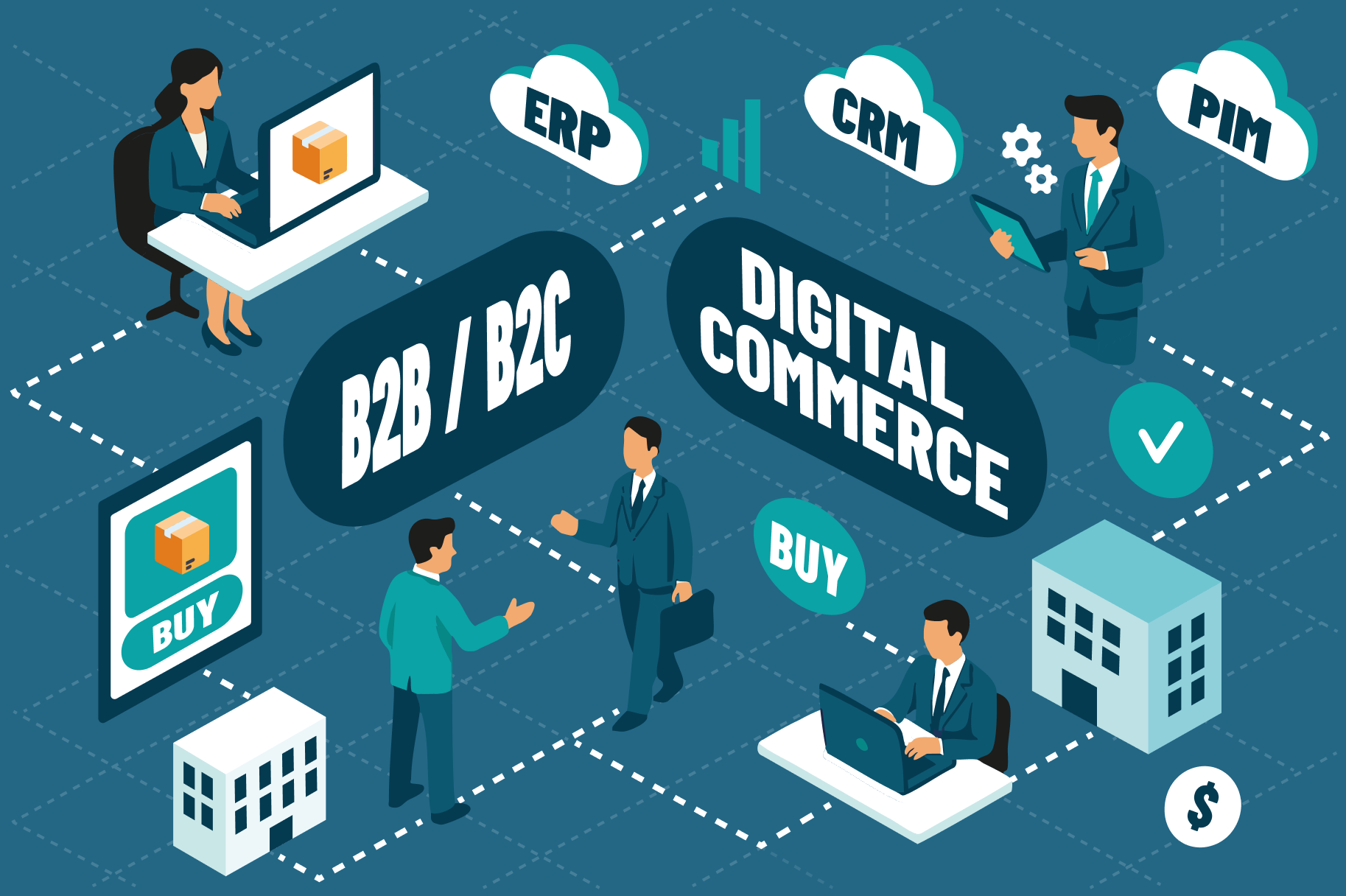
Digital Commerce goes far beyond online sales. While e-commerce typically refers to the sale of products or services over the internet, Digital Commerce encompasses a much broader scope — including marketing, customer service, product development, sales processes, and the technological integration across the entire value and sales chain. It’s not a product, but a systemic approach. The goal is to connect digital touchpoints meaningfully along the customer journey — especially in B2B contexts, where processes are often complex and multi-layered.
In practice, the shape of a Digital Commerce strategy depends heavily on a company’s size, existing IT infrastructure, and level of digital maturity. Larger enterprises often rely on fully integrated, modular platforms, while many mid-sized businesses take a hybrid approach — for example, by combining an existing online shop with ERP, CRM, or PIM systems. What matters most is not the completeness of all systems, but the smart integration and scalability of digital sales solutions within the company’s specific context.
At its core, Digital Commerce is about building a scalable digital sales ecosystem in which technology, processes, and user experience work together seamlessly. This includes classic online shops as well as product configurators, customer portals, ERP or PIM integrations, and automated quoting and service processes. Digital Commerce is therefore not merely a sales channel — it’s an integral part of operational and strategic value creation. It provides the structural foundation that makes digital sales solutions sustainable in the long term — aligned with products, markets, and internal workflows.
We’re aware that the term Digital Commerce is not uniformly defined. In literature and practice, you’ll find varying interpretations and distinctions. Sometimes it’s used synonymously with terms like e-business, omnichannel commerce, or Commerce 4.0. Our understanding is based on a holistic perspective that integrates the technological, organizational, and strategic dimensions of digital sales.
How does Digital Commerce differ from E-Commerce?
E-Commerce refers to digital sales through platforms — usually in the form of an online shop. The focus lies on transactions: finding a product, adding it to the cart, making a purchase. Digital Commerce, on the other hand, looks at the entire interaction between a company and its customers — from configuring complex products, integrating internal systems, and managing data flows to enabling self-service portals and automated processes. While E-Commerce often operates as a stand-alone solution, Digital Commerce is embedded within existing IT architectures, taking business operations and technological dependencies into account. This makes it especially relevant for companies with complex sales structures or products that require explanation — particularly in the B2B sector.
In short, Digital Commerce is an integrated system. E-Commerce is one channel within it.
However, Digital Commerce is more than just a technological evolution of E-Commerce. It’s part of a broader digital business strategy that encompasses the entire digital value chain — from marketing and sales to service, data, and system architecture. Digital Commerce is therefore a core element of digital transformation — not only in sales, but across the entire business model.
Why is Digital Commerce becoming increasingly important?
Growing Complexity
Especially in the industrial and B2B sectors, many products can no longer be represented through simple shop systems. Variants, configurations, and technical requirements demand digital support — from product setup and pricing to integration with internal systems.
Changing Customer Expectations
Whether end customers or business partners — everyone expects smooth processes, quick access, intuitive usability, and consistent experiences across all channels. At the same time, B2B buyers increasingly expect B2C-like user experiences. This trend, often referred to as the consumerization of B2B, significantly raises the bar for usability, personalization, and customer-centric design.
Rising Demands for Efficiency and Scalability
Digitalized processes shorten quotation and ordering cycles, reduce sources of error, and enable automated data flows — creating more efficient operations and scalable growth potential.
Technological Opportunities
APIs, cloud infrastructures, headless architectures, and integrations with ERP, CRM, and PIM systems form the foundation for future-ready sales models. In addition, AI-driven applications open up new possibilities — for example in personalized recommendations, automation, and intelligent process optimization.
Digital Commerce in Practice
Online Shops & Platforms
A modern online shop is much more than a catalogue with a shopping cart. It’s embedded in a comprehensive system of product, customer, and service data — connected with logistics, CRM, and ERP systems. What matters most is scalability and flexibility: the platform should integrate seamlessly into existing IT landscapes, whether through Shopify (Plus) or other headless and API-based solutions that enable modular, future-ready architectures.
Product Configuration & CPQ (Configure-Price-Quote)
For products with numerous variants or complex consultation needs, configurators and CPQ systems are essential. They enable individual product setups, automated pricing, and efficient quote generation — reducing errors and accelerating the entire sales process.
Customer & Partner Portals
Digital portals support customers and partners after the purchase or through self-service — for example, with orders, tracking, or service requests. This eliminates media disruptions (such as manual data transfers between systems) and enhances the overall user experience.
Technical Integration & System Landscape
Key interfaces connect to ERP, CRM, PIM, and DAM systems — because true efficiency only emerges when data flows seamlessly. Architectures based on headless CMS or microservices are becoming increasingly important, enabling flexible, scalable, and future-proof system environments.
Data, Analytics & AI
Digital processes generate valuable data — who buys what, when, and how? Using this information enables personalization, automation, and targeted optimization, for example through AI-powered recommendations or digital assistants that enhance both efficiency and user experience.
Strategic Development and Maturity Assessment
Digital Commerce is not a one-time project — it’s a continuous development process. Companies should regularly assess the digital maturity of their commerce systems and processes. Using maturity models, they can identify strengths, weaknesses, and development priorities — building a sustainable, future-oriented Digital Commerce strategy that evolves alongside their business goals and market dynamics.
Conclusion
Digital Commerce is more than just technology — it’s a strategic approach to digital sales. Companies that want to make their sales solutions future-proof must take a holistic view of processes, systems, and user needs. Especially in the B2B environment, Digital Commerce offers the opportunity to manage complexity, increase internal efficiency, and meet growing customer expectations at the same time. It should not be seen as a one-time project, but as a continuously evolving system that adapts and grows with the business.