
Digital commerce agency specialising in complex sales processes
Digital commerce solutions for complex products, processes and system landscapes
Complexity becomes a digital strength
Digital commerce integrates online shops, product configurators, customer portals and ERP, CRM and PIM systems to create end-to-end digital sales processes. Sitewerk develops scalable digital commerce solutions for businesses that deal with complex products, customised quotation processes and have high requirements in terms of integration, user experience and automation.
What is digital commerce?
Digital commerce encompasses the entire digital sales process and therefore goes beyond the traditional online shop. This includes, amongst other things, product information, configuration, pricing logic, quotation generation, ordering, customer portals, self-service and after-sales processes.
The aim is to create a seamless digital customer journey that better supports customers and makes internal sales processes more efficient. In the B2B sector in particular, this creates a scalable foundation for selling complex products more easily online. A suitable digital commerce solution combines technology, product data and sales processes into a single platform that remains expandable in the long term.
Why digital commerce is important for complex sales processes
Many B2B companies still sell products that require explanation or are configurable via manual processes. Product data is stored in various systems, quotations are time-consuming to prepare, and customers have to contact the sales team for much of the information they need. Digital commerce integrates these processes into a scalable platform. Product information, configurators, customer portals, ERP integrations and automated quotation processes work together to enable self-service, faster sales cycles and better digital product experiences.
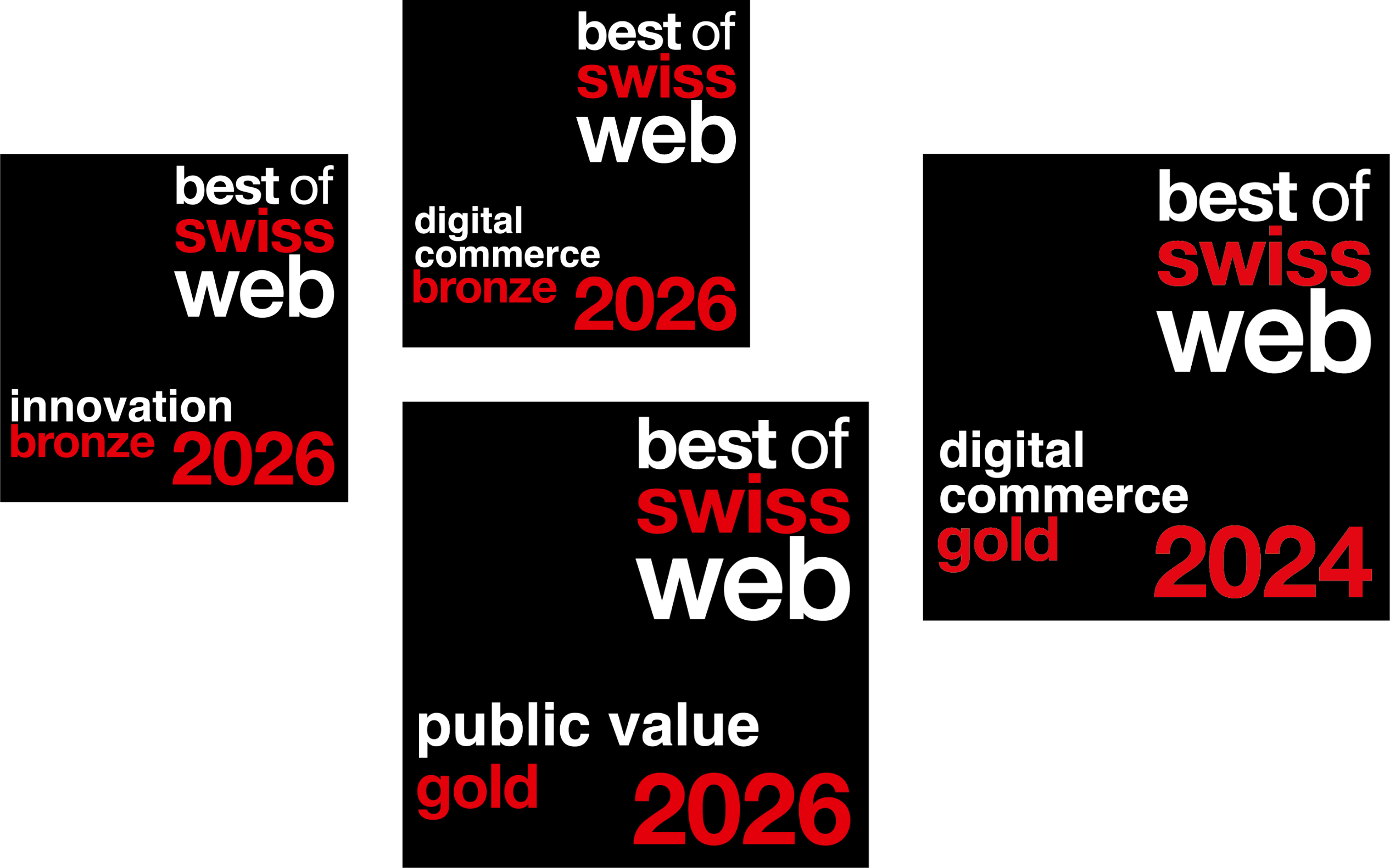
Top 5 digital commerce service providers at Best of Swiss Web
We are one of Switzerland’s leading e-commerce agencies. In 2026, we received nine awards, including a gold award in the Public Value category. As early as 2025, one of our technical implementations made it onto the shortlist. At the 2024 Best of Swiss Web Awards, we won three awards: gold for Digital Commerce, silver for Business, and bronze for Innovation.
These awards confirm our commitment to successfully designing and developing complex e-commerce projects and creating measurable added value for companies and organizations.
Our building blocks for digital commerce
Partner & Customer Portals
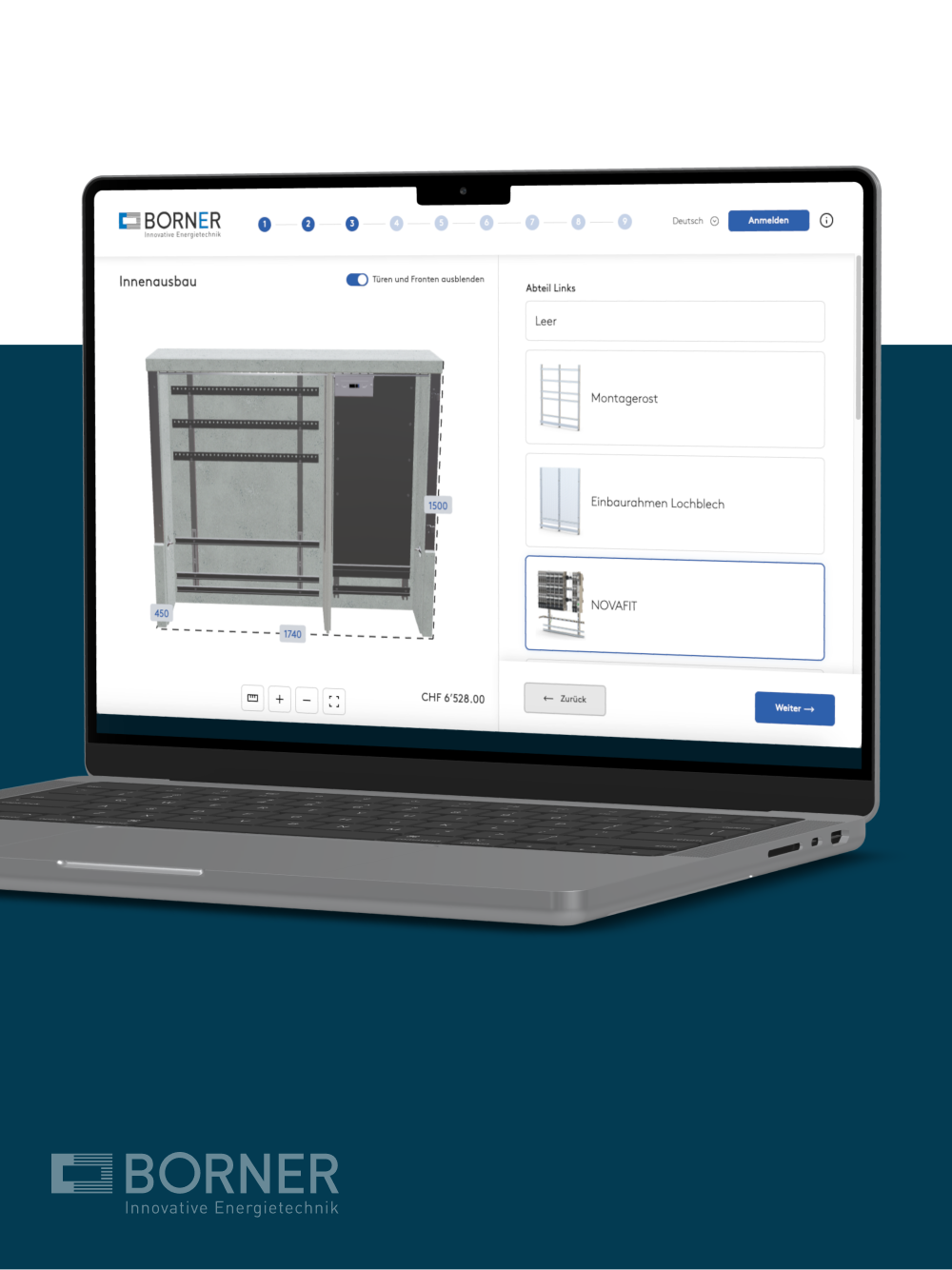
«The digitalization rate of configurable products is currently over 50%. With planned adjustments, we will be able to increase this figure even further.»
Philipp Gisi, Head of E-Commerce, F. Borner AG
Real-world digital commerce projects
References
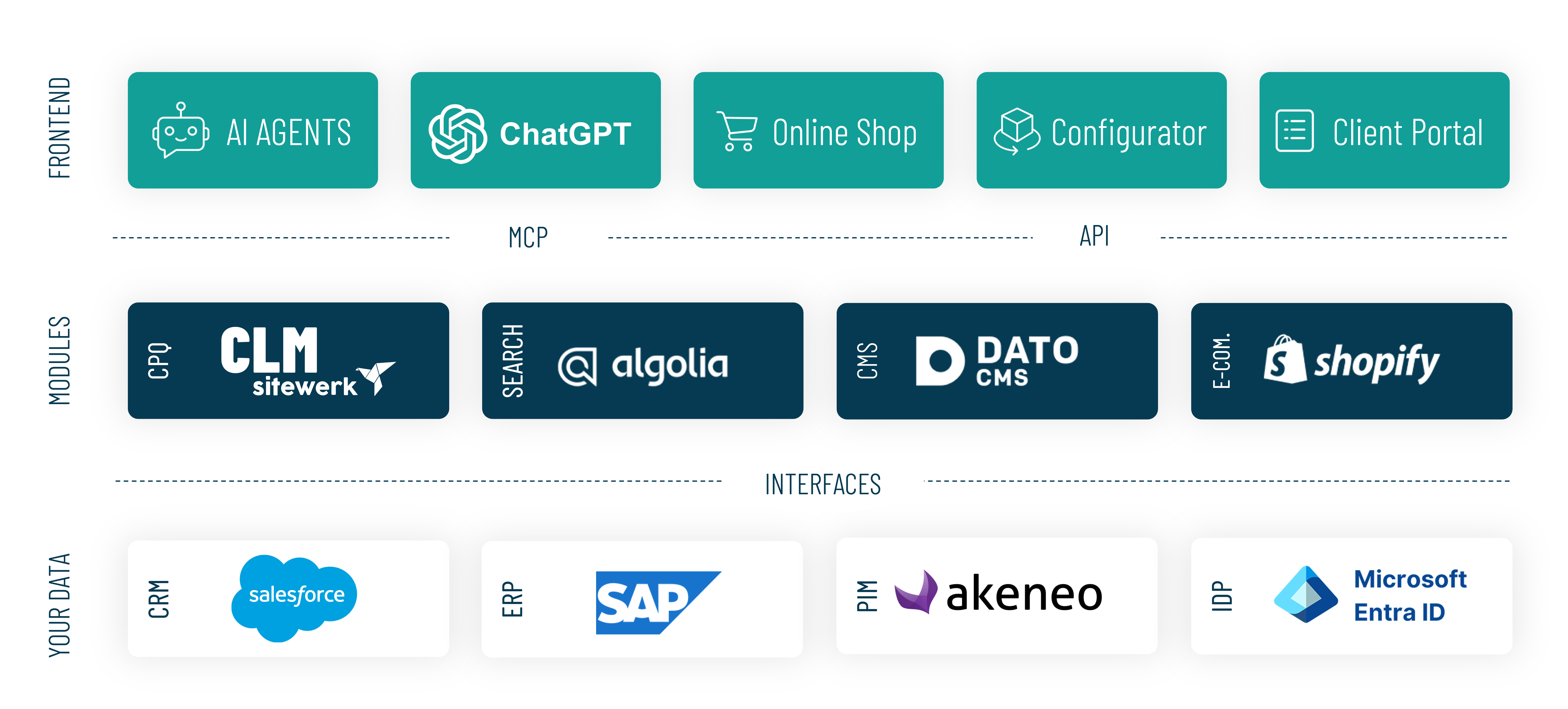
Up to 100% digital sales processes with our modules
Our digital commerce modules can be flexibly combined and customised to suit your system landscape, your products and your processes. This results in digital sales platforms that not only optimise individual touchpoints but also automate entire sales processes. Depending on your requirements, we integrate commerce platforms, CPQ solutions, customer portals, ERP, CRM and PIM systems, AI services and modern web technologies into a scalable solution. This enables companies to digitise their operations step by step, without having to carry out costly complete relaunches.

Shopify Plus Partner
With Shopify Plus, we create high-performance, fully customized online shops that integrate seamlessly with existing systems, from ERP to logistics. Thanks to flexible APIs, automatable workflows, and external integrations, even complex business processes can be efficiently managed digitally – whether for end customers or business clients.
Key questions about digital commerce
- What is digital commerce?
Digital commerce encompasses far more than just a traditional online shop. As well as the sale of products, it also includes digital services, customer portals, product configurators, marketing automation and integrations with existing systems such as ERP, CRM or PIM systems. The aim is to establish a seamless digital sales process – from initial product information through to configuration, ordering and after-sales service.
- What is the difference between e-commerce and digital commerce?
E-commerce primarily refers to the sale of products and services via an online shop. Digital commerce, on the other hand, encompasses the entire digital sales process. This includes, amongst other things, product data, customer portals, configurators, quotation processes, system integrations and digital services. Whilst e-commerce focuses on the sales channel, digital commerce considers the entire digital customer journey.
- Which businesses is digital commerce suitable for?
Digital commerce is particularly well-suited to businesses with complex products, bespoke sales processes or multiple sales channels. These include B2B companies in the industrial, construction, wholesale, energy, retail and manufacturing sectors. Digital commerce is particularly relevant when product data is stored in different systems, quotations are created manually, customers expect self-service, or existing e-commerce solutions are no longer flexible enough. In these cases, integrated platforms with ERP, CRM and PIM integration form the basis for efficient digital sales processes.
- What are the benefits of digital commerce?
Digital commerce enables companies to offer their products and services digitally around the clock and to streamline their sales processes. Customers can research, configure or order products themselves, whilst internal processes are becoming increasingly automated. At the same time, new opportunities are opening up for personalised offers, access to international markets and data-driven decision-making in sales and marketing.
- Which systems can be integrated into a digital commerce platform?
A digital commerce platform can integrate various systems, such as ERP, CRM, PIM, CMS, DAM, CPQ, payment, logistics, analytics and marketing automation. Product data, prices, customer data, orders and other information are made available across systems via APIs or middleware.
- What technologies are used in digital commerce?
In digital commerce, a range of technologies are used depending on the requirements. These include, for example, commerce platforms such as Shopify Plus, headless CMSs such as Sanity or DatoCMS, ERP, CRM and PIM systems, product configurators, CPQ solutions, APIs, cloud infrastructures, AI services and analytics tools. It is crucial to have an architecture that integrates these systems effectively and remains scalable in the long term.
- How can digital commerce boost turnover?
A well-thought-out digital commerce strategy improves the customer journey, reduces shopping cart abandonment and automates sales processes. Conversion rates can be boosted through better product experiences, personalised recommendations, self-service features and fast ordering processes. At the same time, new sales channels can be tapped into and international markets served more easily.
- What is the typical process for a digital commerce project?
A digital commerce project usually begins with an analysis of existing sales processes, the system landscape and the requirements. This is followed by the development of a target vision, architectural planning, UX design, visual design and technical implementation. Work is often carried out iteratively, so that initial features can go live quickly and are then expanded step by step.