
Shopify Plus agency specialising in sophisticated e-commerce solutions
For high-performance online shops and e-commerce

E-commerce solutions with Shopify Plus
As a Shopify Plus partner, we deliver e-commerce solutions for businesses with complex products, processes and system landscapes. We integrate Shopify Plus with ERP, PIM, CRM and logistics systems, develop bespoke online shops and create commerce platforms that can be expanded in a modular fashion.
This results in professional e-commerce solutions for B2B, B2C and D2C that combine a stable SaaS infrastructure, rapid development cycles and flexible integrations.
What is Shopify Plus?
Shopify Plus is an enterprise e-commerce platform from Shopify, designed for businesses with high demands in terms of growth, automation, internationalisation and system integration. The platform is suitable for B2B, B2C and D2C business models and can be connected via APIs to ERP, PIM, CRM, logistics and other systems.
As a Shopify Plus agency, Sitewerk supports businesses with strategy development, UX/UI design, technical implementation, system integration and the further development of sophisticated e-commerce solutions.
Benefits of Shopify Plus
High-performance SaaS infrastructure
Shopify Plus offers a stable e-commerce platform for businesses with high demands in terms of operations, performance and availability. Teams no longer need to manage their own shop infrastructure and can therefore focus more on development, conversion and the customer experience.
Rapid further development
With Shopify Plus, new sales channels, markets, features and campaigns can be implemented efficiently. Standardised platform functions, apps, APIs and automations reduce the technical maintenance workload and shorten development cycles.
Flexible scalability
Shopify Plus can be adapted to existing business processes using apps, APIs and bespoke developments. ERP, PIM, CRM, payment, logistics and marketing automation systems can be integrated, ensuring that product data, prices, orders and customer data are available across all systems.
Automation with Shopify Flow
Shopify Flow allows you to automate recurring tasks, such as those relating to orders, segmentation, internal notifications or operational workflows. This enables e-commerce teams to manage their processes more efficiently and reduce manual work.
Headless Commerce
Shopify Plus can be used as a commerce backend in a headless architecture. In this setup, the frontend is developed independently, whilst Shopify provides core commerce functions such as products, the shopping basket and checkout.
Shopify Plus for B2B commerce
Shopify Plus supports B2B commerce with features such as corporate accounts, customer-specific catalogues, customised price lists and multiple buyer roles. Combined with ERP, PIM and CRM integrations, even more complex B2B sales processes can be mapped digitally. Shopify Plus can provide a stable foundation for digital self-service processes, customer portals and international B2B shops for businesses with multiple customer groups, bespoke terms and conditions or recurring orders.
When does headless commerce with Shopify Plus make sense?
Shopify Plus can be used either with Shopify themes or with a bespoke front-end. This architecture is known as headless commerce. In this setup, Shopify Plus handles key commerce functions such as product data, the shopping basket, checkout and orders in the background. The visible user experience is designed and developed independently of this. Headless Commerce is a good option when businesses require highly customised user experiences, high performance or multiple digital touchpoints. These include, for example, websites, apps, customer portals, 3D visualisations, personalisation or international commerce set-ups.
For many e-commerce projects, however, the classic Shopify architecture with themes, apps and APIs is sufficient. Headless is particularly worthwhile when design, content, performance or system integrations need to be more highly customised.
Shopify Plus as a building block for composable commerce
Composable commerce means that an e-commerce platform is built using a modular approach. Rather than incorporating all functions into a single system, specialised solutions such as Shopify Plus, CMS, PIM, ERP, CRM or customer portals are interconnected via APIs. Within such an architecture, Shopify Plus can handle the commerce side of things, namely product management, the shopping basket, checkout and orders. Additional systems are integrated as required, for example for content, product data, customer data, logistics or self-service processes.
This approach is particularly well-suited to businesses that wish to continue using existing systems, integrate new features more quickly or expand their e-commerce platform in stages.
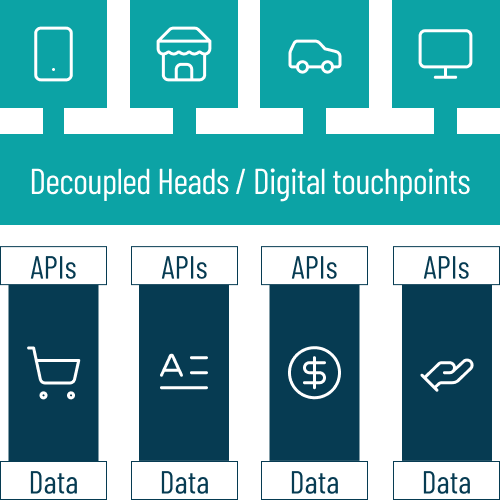
More context on the architecture
Would you like to gain a better understanding of how Shopify Plus, headless commerce and composable commerce are linked? In our blog post, we explain what composable commerce is all about, what benefits the modular approach offers, and when it is suitable for e-commerce projects.

Top 5 digital commerce service providers at Best of Swiss Web
We are one of Switzerland’s leading e-commerce agencies. In 2026, we received nine awards, including a gold award in the Public Value category. As early as 2025, one of our technical implementations made it onto the shortlist. At the 2024 Best of Swiss Web Awards, we won three awards: gold for Digital Commerce, silver for Business, and bronze for Innovation.
These awards confirm our commitment to successfully designing and developing complex e-commerce projects and creating measurable added value for companies and organizations.
These Successful Online Shops have already been implemented by us

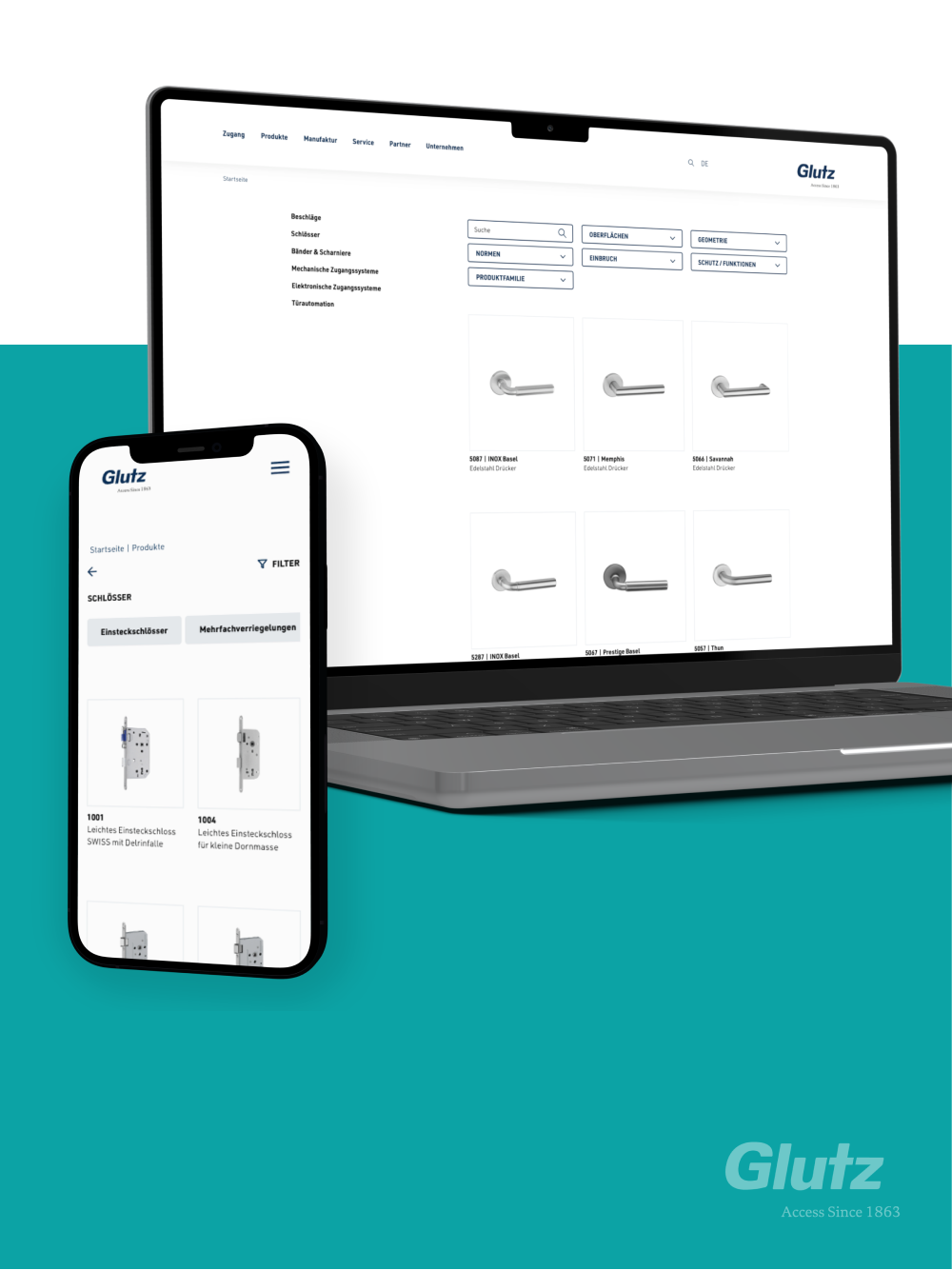
References
From Shopify Plus to Digital Commerce
Shopify Plus is often a central component of a comprehensive digital commerce solution. It is only by combining it with product data, system integrations, customer portals, automation and UX that a commerce platform for complex sales processes is created.
Shopify Plus provides the commerce layer, whilst Digital Commerce connects further building blocks such as CPQ, product configurators, ERP, CRM and PIM systems, agent-based commerce and digital self-service processes.
FAQ – Frequently Asked Questions
- What is the difference between Shopify and Shopify Plus?
Shopify Plus is aimed at businesses with more demanding requirements in terms of growth, automation, internationalisation and integration. As well as offering enhanced capabilities for APIs and workflows, Shopify Plus provides features for B2B commerce, international markets and more complex commerce processes.
- Which businesses is Shopify Plus suitable for?
Shopify Plus is particularly suitable for businesses with a growing online presence that operate in international markets, utilise multiple sales channels, or have complex B2B, B2C and D2C processes. Shopify Plus is particularly relevant when a stable SaaS commerce platform is required that can integrate with ERP, PIM, CRM, logistics or customer portal systems. Businesses planning to adopt headless commerce, composable commerce or a phased modernisation of their existing shop landscape also benefit from the platform’s flexibility.
- Can Shopify Plus handle complex B2B e-commerce processes?
Yes, because Shopify Plus supports B2B commerce with features such as corporate accounts, customer-specific catalogues, customised price lists and buyer roles. When combined with ERP, PIM or CRM integrations, even more complex B2B sales processes can be mapped digitally.
- Can Shopify Plus be integrated into existing system environments?
Yes, Shopify Plus can be integrated with ERP, PIM, CRM, logistics, payment, CMS or customer portal systems via APIs or middleware. Typically, the ERP system remains the primary system for orders, pricing and stock levels, whilst Shopify Plus handles the e-commerce layer.
- Can we also use Shopify Plus in a headless e-commerce architecture?
Yes, Shopify Plus can be used as a commerce backend in a headless architecture. In this model, the frontend is developed independently and connected via APIs to Shopify Plus, a headless CMS or other systems.
- How flexible is Shopify Plus when it comes to customised business processes?
Shopify Plus offers a robust standard platform and a wide range of customisation options via apps, APIs, Shopify Flow, bespoke front-ends and system integrations. This enables many business processes to be mapped out efficiently, whilst Shopify takes care of operations, security and updates.
- How does Shopify Plus support international e-commerce strategies?
Shopify Plus supports international e-commerce strategies with features for multiple markets, languages, currencies and regional shops. This enables businesses to manage global commerce structures efficiently whilst taking country-specific requirements into account.
- How much work is involved in switching from an existing e-commerce platform to Shopify Plus?
The effort involved depends on the existing system landscape, data quality, integrations and the required functions. Typically, product data, customer accounts, order histories and existing integrations are analysed, migrated and reconnected. Many companies also use the switch as an opportunity to fundamentally modernise their e-commerce architecture.