What is composable commerce and when does it make sense for an e-commerce project?
Imagine you run a high-turnover online store that is strategically important for your fast-growing company. As the market and the company's demands on the system are constantly changing, a new evaluation and a complete platform relaunch every few years is unavoidable in order to keep up with the latest technological developments and to be able to scale the company further. This means a great deal of effort and correspondingly high costs.
There is a smart solution for the scenario described above: composable commerce. Or in short: A modular and therefore flexible and scalable architecture for sophisticated e-commerce solutions.
What exactly is Composable Commerce?
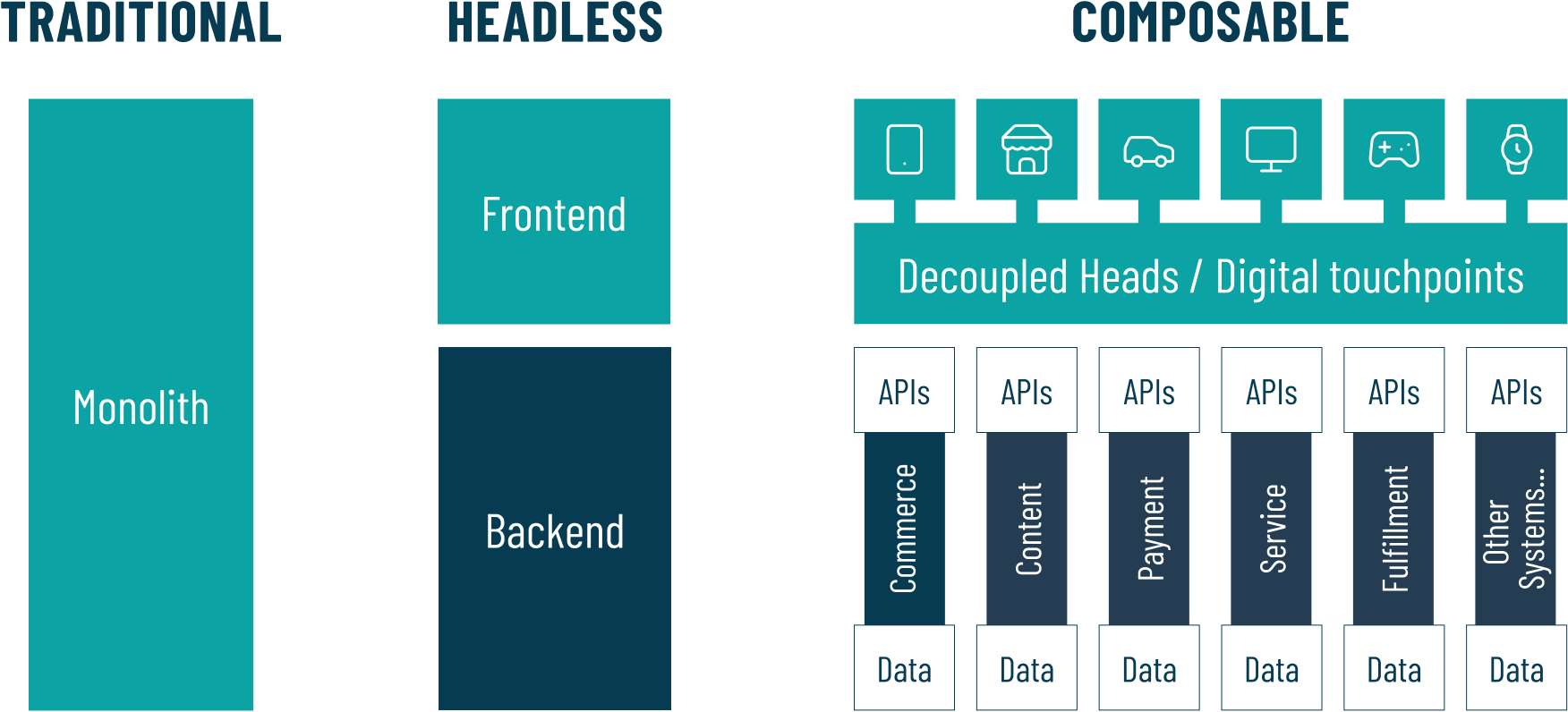
Composable commerce is a modern approach to e-commerce in which the online store architecture consists of modular building blocks. These building blocks can be flexibly combined to create highly customized and scalable e-commerce solutions that meet specific business requirements. In contrast to monolithic systems, where the entire system is based on one technology, composable commerce allows more flexibility in the selection of individual functional areas (product and order management, payment processing, support and analytics) and can therefore meet requirements in the best possible way. The system can also be continuously improved and adapted to new requirements by replacing or upgrading individual modules.
Advantages of Composable Commerce
Modularity
Companies can select exactly the components they need and easily add new ones or replace existing ones without changing the entire system. Systems and services are developed as individual, independent modules.
Flexibility and expandability
For projects that start with a small scope and have the potential to grow quickly, Composable Commerce offers easy scaling, as it can be expanded selectively to meet new requirements.
Scalability
As Composable Commerce relies on SaaS (Software-as-a-Service) or cloud software, scaling is largely automatic when there is a high load, e.g. Christmas sales.
Cost efficiency
Although the initial costs are somewhat higher due to the complexity of the system, you save a lot of money in the long term because you never have to build a completely new system and SaaS products mean you don't have to spend money on maintenance and hosting.
Low maintenance costs
Composable Commerce relies on cloud services, so there is no need to worry about the infrastructure and therefore no need for expensive security updates and system migrations.
Disadvantages of composable commerce
Composable commerce brings with it increased complexity, as the integration and management of a modular architecture requires in-depth technical knowledge and effective project management. An experienced development team and a strong DevOps team are also required.
In addition, implementation often takes longer than with traditional e-commerce platforms, where many requirements are covered out-of-the-box by a monolithic system.
MACH architecture (microservices, API-first, cloud-native and headless)
The term MACH architecture is often used in connection with composable commerce. Composable commerce is closely based on the modern MACH architecture principle and makes it possible to develop flexible, scalable and adaptable commerce solutions.
MACH stands for microservices, API-first, cloud-native and headless.
Microservices means that applications are divided into small, independent modules that perform specific functions. This enables independent development, provision and scaling of the individual services.
API-first means that the interaction between the components takes place via standardized interfaces (APIs), which enables seamless integration and communication between different systems and applications.
Cloud-native refers to the fact that applications and services are developed and operated in the cloud, making them highly scalable and available and allowing them to take advantage of the cloud infrastructure.
Headless means that the front end is separate from the back end, which enables the development of different front ends for different channels and creates flexible, consistent user experiences across different devices and platforms.
Which well-known composable commerce providers are there on the market?
There are numerous technologies available for composable commerce that help companies create comprehensive e-commerce platforms. Here are some of the main technologies and platforms that are commonly used:
Commercetools
Commercetools offers an extremely flexible, API-first and cloud-native platform that is ideal for large companies with complex requirements. Thanks to its microservices architecture, it allows various e-commerce functions to be integrated independently of each other, making it particularly interesting for tech-savvy teams.
Shopify Plus is aimed at medium-sized companies that are growing rapidly and need a scalable, hosted e-commerce platform. It offers ease of use with pre-built functionality, while also allowing a degree of flexibility for bespoke solutions through headless commerce.
Spryker
Spryker is a modular e-commerce platform designed specifically for companies that require complex and customized solutions, whether B2B or B2C. With a headless and API-first architecture, it is particularly suitable for technology-oriented companies that want comprehensive control over their platforms.
BigCommerce
BigCommerce offers an easy-to-use, hosted solution for small to medium sized businesses looking to quickly build a powerful online presence. With its headless commerce options and strong integrations, it enables fast implementations without sacrificing flexibility.
Commerce Layer
Commerce Layer is ideal for companies with an international focus that require a flexible, API-based e-commerce solution. It offers strong support for multi-currency and multi-warehouse management and is therefore particularly suitable for companies that want to operate and scale globally.
When is a composable commerce approach worthwhile for a project?
For small companies that have less complex requirements for an online store and therefore standard use cases are sufficient, a complex composable commerce architecture can be dispensed with. For medium-sized and large companies where the online business is growing rapidly, the processes are complex and individual, and you have to react to new technologies or constantly changing market requirements, Composable Commerce can be the ideal solution.
Thanks to the best-of-breed approach, expensive “greenfield online store relaunches” or new starts will never be necessary again: as soon as the system requirements change (e.g. the company grows, the market changes or a new, better technology becomes available), this one module can be replaced selectively without having to rebuild the entire system. With this approach, the volatility of today's market can be absorbed and the system can be updated step-by-step and continuously improved.
Even if the initial project costs and license costs tend to be higher than for a traditional online store project, costs can be saved in the long term thanks to negligible maintenance costs and a sustainable setup.

Swiss Shopify Plus Partner Agency
As an agency, we create high-performance, fully customized e-commerce solutions with Shopify Plus that integrate seamlessly with existing systems – from ERP to logistics. With flexible APIs, automatable workflows, and easy connections to external services, even complex business processes can be efficiently managed digitally – whether in B2C or B2B environments.