Agentic Commerce is fundamentally transforming digital sales
How AI Agents Are Redefining Digital Sales
An online store that isn't visible to LLMs doesn't exist
In the future, purchases in online stores will be made not only through the usual store user interfaces but directly via ChatGPT and similar platforms. This means that e-commerce companies, marketplaces, SaaS providers, and brands with digital sales channels will gain a new target audience: machines , or more specifically, AI. This also opens up a new sales channel and, with it, new opportunities.
AI agents bypass user interfaces entirely and access product data directly via APIs. This means that conversions no longer depend solely on a good user experience, expensive ads, and perfectly optimized SEO, but simply on whether your store is well understood by large language models (LLMs).
It is important to lay the groundwork as soon as possible by ensuring you are technically prepared. Now is the time to reassess your technical infrastructure, decouple systems (keyword: Composable Commerce), and prepare data so that it can be utilized.
The right time to act isn’t “sometime,” but now.
What steps need to be taken right now?
To ensure that an online store is ready, its visibility and discoverability in the search engines must be guaranteed. But what needs to be done to achieve this?
Structured and Standardized Product Data
Products must be semantically enriched. It is important not only to describe products but also to contextualize them (“for whom,” “for which use cases”)
GEO (Generative Engine Optimization)
GEO (Generative Engine Optimization) aims to ensure that products and content are understood, selected, and recommended by AI—not just found.
API-first Architecture
Agents need direct access to the data. The technical maturity of the systems must be ensured.
Real-Time Data
Prices, availability, delivery times, etc. must be made available using robust APIs
Decouple Systems
Gradually replace legacy systems with headless/composable approaches that can be easily integrated via APIs
Experimenting and Testing
Test initial integrations with AI agents, verify and optimize results, and define specific use cases for agents
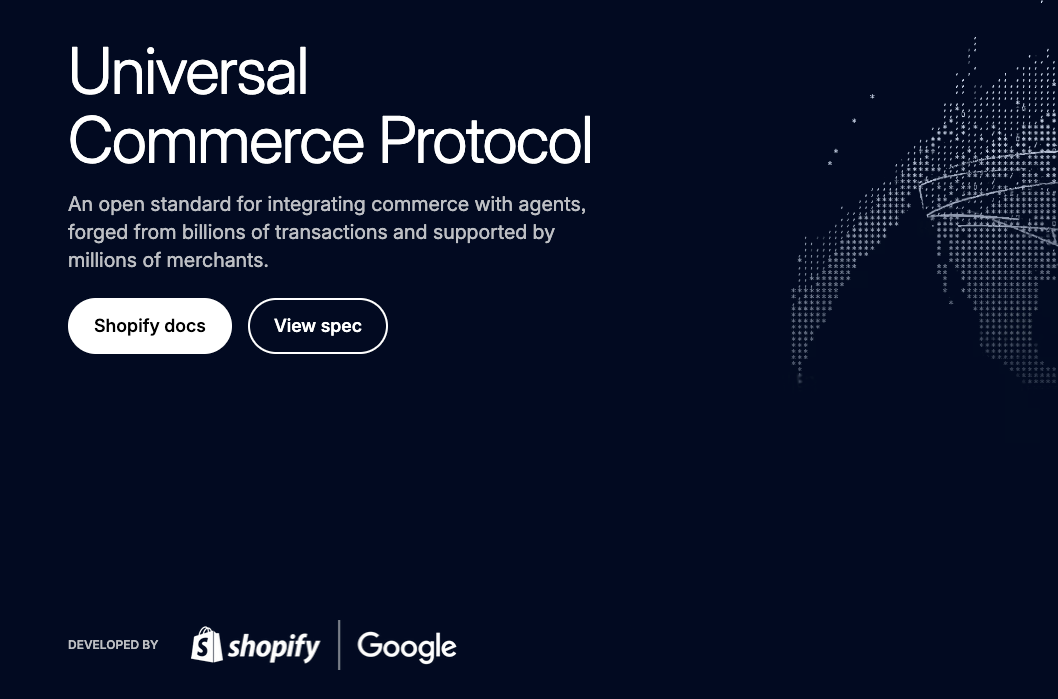
Universal Commerce Protocol (UCP)
To enable purchases directly through LLMs or Google environments, Google has developed the UCP (Universal Commerce Protocol) in collaboration with Shopify and many other global players. This marks a new industry standard for the entire sector.
UCP enables AI agents to search, compare, and purchase independently. The protocol covers the entire customer journey, from product search and checkout to order management and upselling experiences.
Agentic Commerce Protocol (ACP)
Like UCP, ACP also pursues the same goal. ACP supports existing LLMs with commerce functionalities to enable direct purchases.
Both approaches follow the same process—they are simply implemented in different contexts.
We are happy to provide guidance on these topics and help companies understand how agentic commerce impacts their business model.
«Agentic Commerce could orchestrate up to $5 trillion in global transactions by 2030»
Source: McKinsey
These customers are getting ready for Agentic Commerce with us

Digital commerce journey for B2B
For end-to-end digital sales processes
References
FAQ - frequently aksed questions
- How is Agentic Commerce transforming the B2B purchasing process?
Here, a distinction must be made between simple products and complex, high-cost products. While AI agents can already handle a large part of the sales process for simple products (e.g., a pair of socks), there are often very complex and correspondingly high-cost products (e.g., production machinery) that are sold in the B2B sector. Sales staff remain highly relevant for the distribution of such products, and many steps in the sales process will not be handled by AI agents, even in the long term. The final purchase transaction will continue to be carried out by humans. However, a key factor for these complex products is the ability to find, evaluate, and compare options, as well as obtain an initial quote through AI agents. These steps will become increasingly digitized. For this initial phase of the customer journey, companies must be prepared and make the necessary information available digitally.
- What is the difference between SEO and GEO?
It’s clear that those who have done their homework when it comes to SEO (Search Engine Optimization)—both in the past and present—already have a head start. GEO (Generative Engine Optimization) aims to ensure that products and content are understood, selected, and recommended by AI—not just found. We need to think semantically and not just describe products, but contextualize them (“for whom,” “for which use cases”)
- How should product data be created and enriched so that it can be found?
For AI agents to find and accurately evaluate products, product data must be structured, complete, and machine-readable—traditional SEO optimization and purely technical product attributes are no longer sufficient. Instead of text optimized for human readers, what’s needed are precise, structured attributes, clear classifications, and standardized data formats that an agent can process directly. This is where Product Experience Management (PXM) comes into play: PXM goes beyond traditional PIM and ensures that product information is not only complete but also contextually enriched and delivered in a channel-specific manner. Companies that consistently maintain their product data in a PXM system today are laying the groundwork for their products to even be considered by shopping agents tomorrow.
- What should I do if my store doesn't yet use an API-first approach?
In that case, it’s important to figure out as soon as possible how you can prepare your technical infrastructure for the changes. Feel free to contact us. We’re here to help.
- How can I get started with Agentic Commerce?
Doing and learning! Of course, it’s necessary to first determine whether the current technical infrastructure meets the requirements for integrating UCP and/or ACP, for example. For Shopify and other API-first platforms, this is already very easy to do today. Next, GEO must be actively operated, and the product data must be enriched. Once these requirements are met, it’s best to launch pilot projects as soon as possible and learn from them. Define use cases, then test them and gain experience.