Digital Sales Engine for complex B2B products
Digital distribution systems in the age of agentic commerce
From expert-led sales to a digital sales system
Transform manual quotation processes, expert knowledge and fragmented systems into a seamless, digital sales system. This will enable you to achieve a shorter time-to-quote, lower cost-to-serve and higher conversion rates. In this way, you can drive greater growth without having to hire a proportionally larger workforce.
Sitewerk develops digital sales systems for companies with complex, consultancy-intensive products. Integrated with ERP, CRM, PIM, CPQ, customer portals and artificial intelligence.
When complex sales processes no longer scale
Products requiring extensive consultation cannot be sold in the same way as standard products. It often takes several days or weeks to draw up quotations, as product knowledge, pricing logic, customer data and relevant information from various sources are not available in a structured format. This information frequently has to be collected, validated and organised into a usable format before a quotation can be drawn up.
This complexity is often absorbed by the existing sales team. Additional clarifications, queries and manual intermediate steps end up being handled by the same staff members. This leads to a higher workload, a longer time-to-quote and reduced chances of closing deals, as customers have to wait longer for reliable quotations.
Typical challenges include:
- Quotation processes take too long
- Knowledge is concentrated among individual experts
- ERP, CRM, PIM and CPQ are not fully integrated
- Customers experience disjointed experiences rather than a clearly guided process
- Sales costs are rising due to manual processes
- Conversion rates are stagnating or declining
- Growth usually requires additional staff
- AI and agentic commerce are virtually impossible to implement with fragmented data
The solution: Transforming the sales department into a digital sales engine
A digital sales engine makes sales success more predictable and less dependent on individual people. It digitally maps product and pricing logic, expert knowledge, data and process steps, and links these together to form an end-to-end sales system. This automates manual processes, makes knowledge systematically available and guides customers in a targeted manner throughout the sales process. Existing systems such as ERP, CRM, PIM, CPQ and customer portals are integrated, so that individual sales activities form part of a repeatable, systematic approach.
In this way, sales evolves from a people-dependent process into a digital system that captures demand in a structured manner, better qualifies sales opportunities and measurably supports growth.
What exactly is changing?
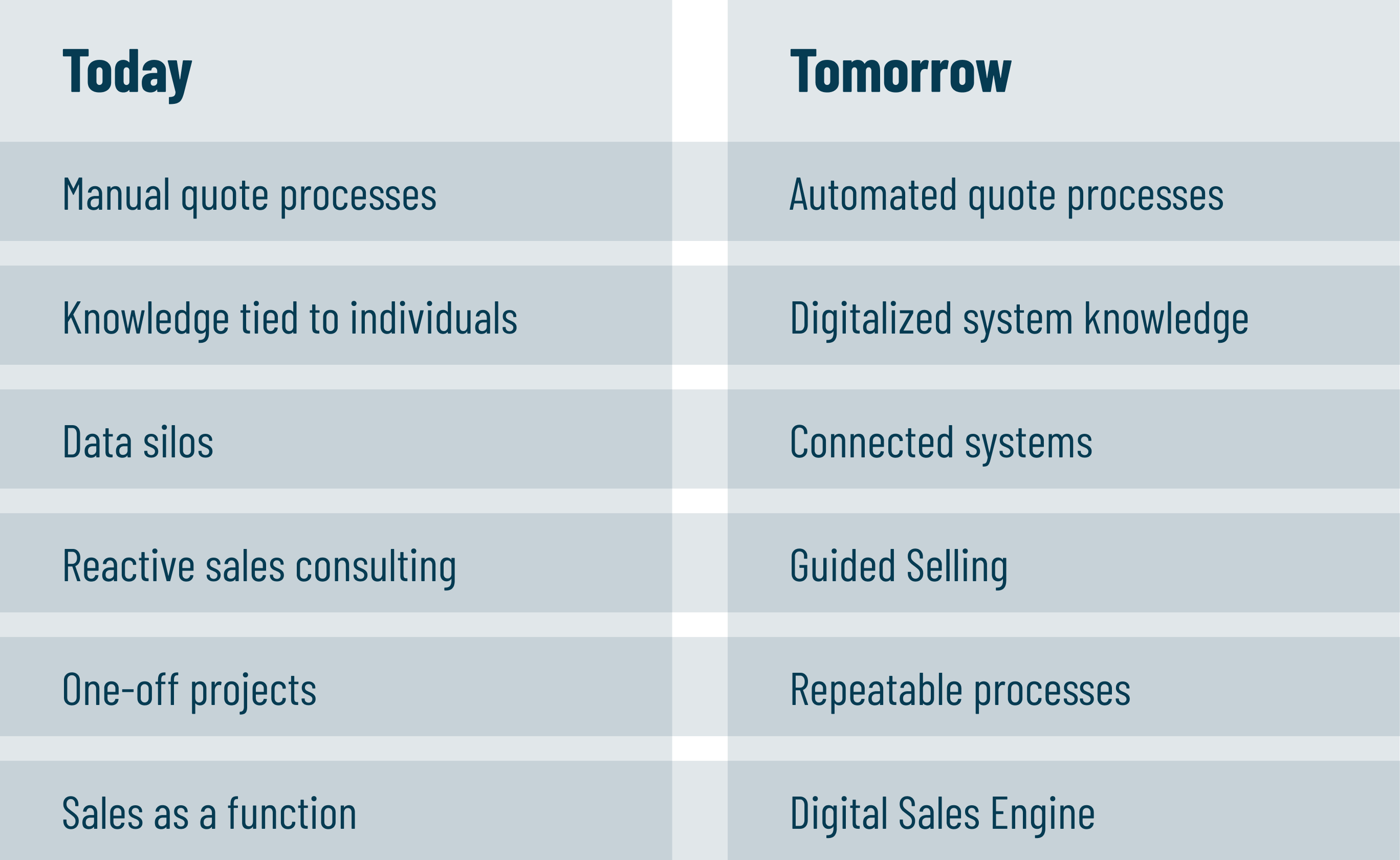
A Digital Sales Engine does more than just optimise individual process steps. It transforms the way sales operates. Sales teams become faster, more consistent, more data-driven and less reliant on manual tasks.
Shorter time-to-quote
Enquiries are qualified more quickly, product logic is mapped digitally and quotations are prepared automatically.
Lower cost-to-serve
With less manual work, fewer queries and less coordination, the effort required per sale is reduced.
Higher conversion rates
Guided selling, consistent information and quick response times improve the likelihood of closing a deal.
Greater growth without a corresponding increase in staff numbers
Automated workflows lay the foundations for growth without a corresponding increase in sales effort.
How to build your digital sales engine
From analysis to a scalable solution
A successful digital sales engine is built step by step. It all starts with a concise digital sales audit: we analyse your current sales processes, product data and system integrations, and identify the key areas for improving efficiency and driving growth. In doing so, we examine where time is being wasted, where manual effort is required, and where data, systems or processes are holding back your sales team. Our aim is to reduce time-to-quote, lower cost-to-serve, increase conversion rates and enable growth without proportionally increasing headcount.
On this basis, we develop a clear vision for your Digital Sales Engine, define an MVP roadmap and produce an initial assessment of the business case. We then implement the solution iteratively and continuously optimise it based on relevant KPIs.
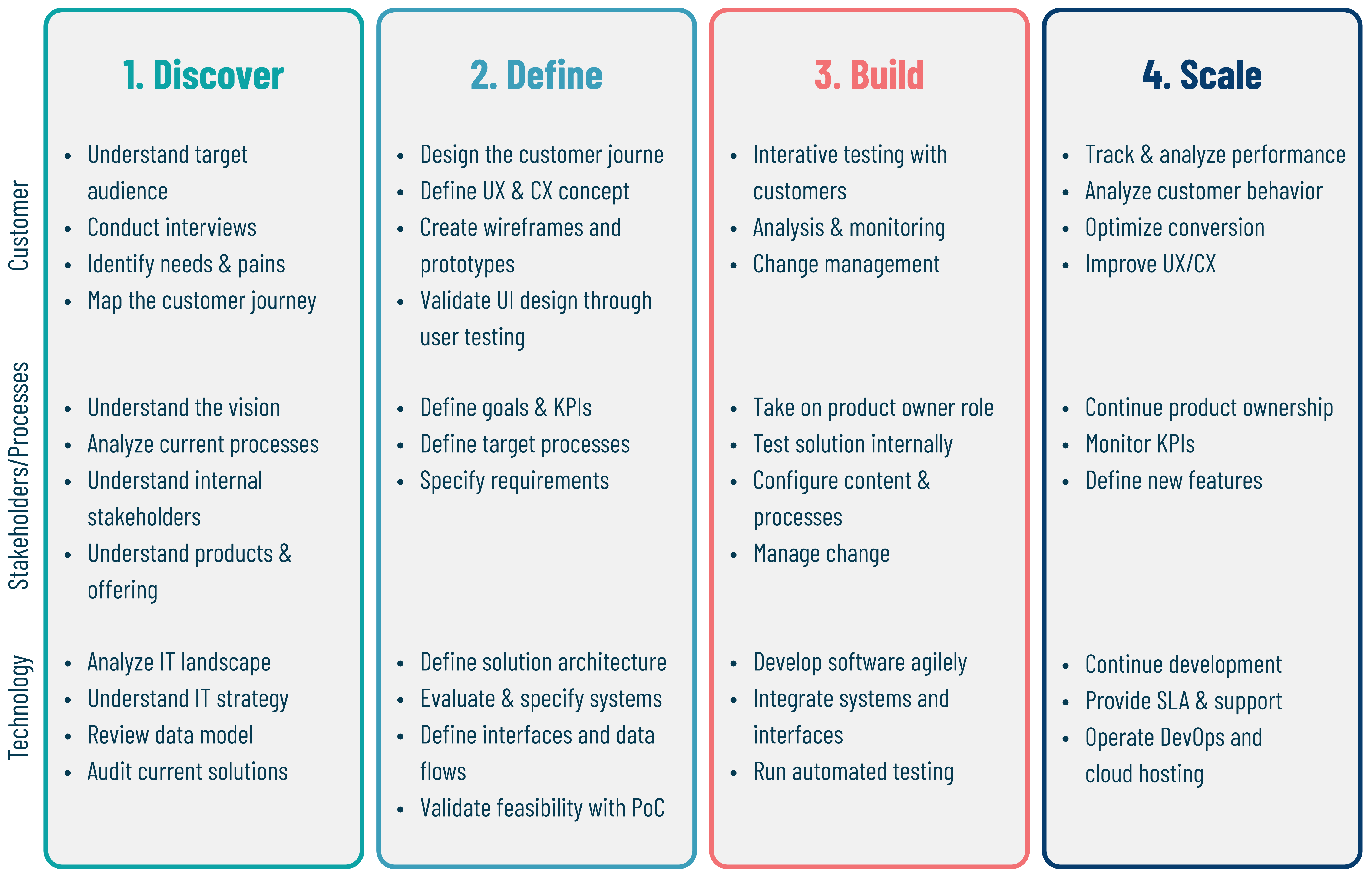
Discover
We analyse processes, products, target groups, the system landscape and data quality. Outcome: process analysis, system map, pain point mapping and KPI baseline.
Define
We develop the vision for your Digital Sales Engine and prioritise its implementation based on business value. Outcome: business case, MVP scope, integration architecture, roadmap and set of KPIs.
Build
We develop the solution iteratively and validate it with users at an early stage. Outcome: MVP, configurator, portal or CPQ functionality, system integration, tracking and automated quotation processes.
Scale
We are constantly developing your Digital Sales Engine. The result: a KPI dashboard, an optimisation backlog, AI use cases, roll-out to other products or markets, as well as operation and support.
Digital Sales Audit: Find out where your sales team is losing time, money and growth
In a concise digital sales audit, we identify the key areas for improvement across the quotation processes, product data and system integration. The aim is to reduce time-to-quote, lower cost-to-serve, increase conversion rates and drive growth – all without a corresponding increase in staff numbers.
You will receive the following within 2 to 3 weeks:
- Analysis of your current sales processes
- System map
- Pain point mapping
- KPI baseline
- Vision for your Digital Sales Engine
- MVP roadmap
- Initial assessment of the business case
Why Sitewerk?
Complex sales require more than just a tool
Standard e-commerce solutions often fall short when it comes to complex products. Pure CPQ systems usually only solve part of the problem. Traditional bespoke software quickly becomes expensive, is difficult to maintain and challenging to develop further. Sitewerk, on the other hand, combines strategy, UX, configurators, online shops, portals, system integration, data and AI into a digital sales system with measurable business impact.
Our strength
We specialise in complex sales models involving variants, rules, prices, roles, approvals, product data and system dependencies. We take an end-to-end approach: from the initial lead through product experience, configuration, quotation and closure, right through to handover to ERP, production, logistics or fulfilment. We combine UX, product experience, CPQ and integration to ensure that customer journey, product logic and the system landscape work together seamlessly. In doing so, we develop digital sales systems that not only automate current processes but are also future-proof for AI and agentic commerce. We measure success using relevant metrics such as time-to-quote, cost-to-serve, conversion rate, self-service usage and revenue growth.
The Digital Sales Engine: From initial contact to measurable growth
A Digital Sales Engine combines product knowledge, pricing logic, customer data and existing systems to create an end-to-end sales process. From lead generation through configuration and quotation to closing the deal, this creates a guided workflow that reduces the workload on sales teams, helps customers find the right solution more quickly and makes growth measurable.
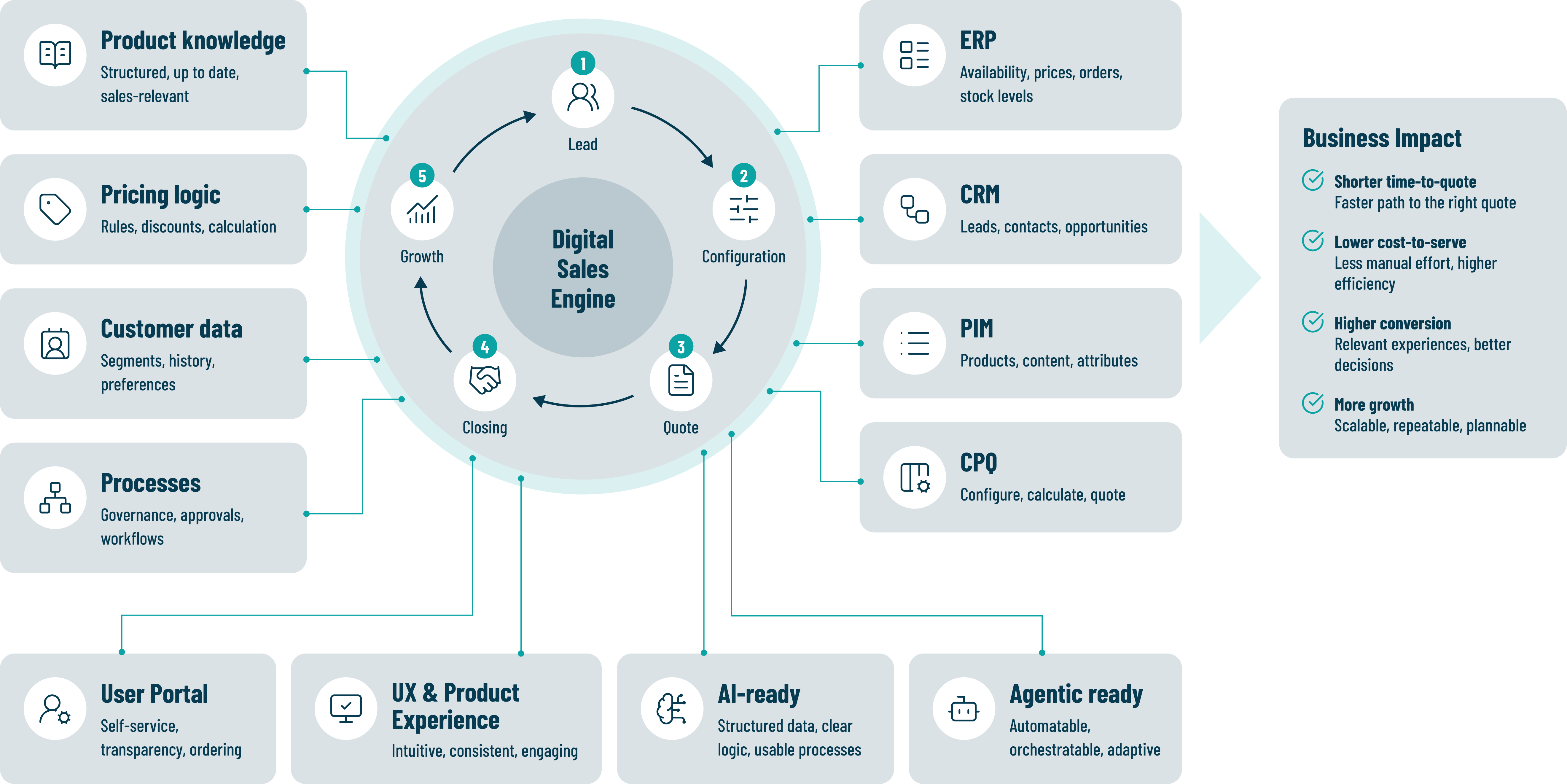
It is based on five levels:
Product & sales knowledge
Integrated systems
Data & Insights
UX & Produkterlebnis
AI & Automation
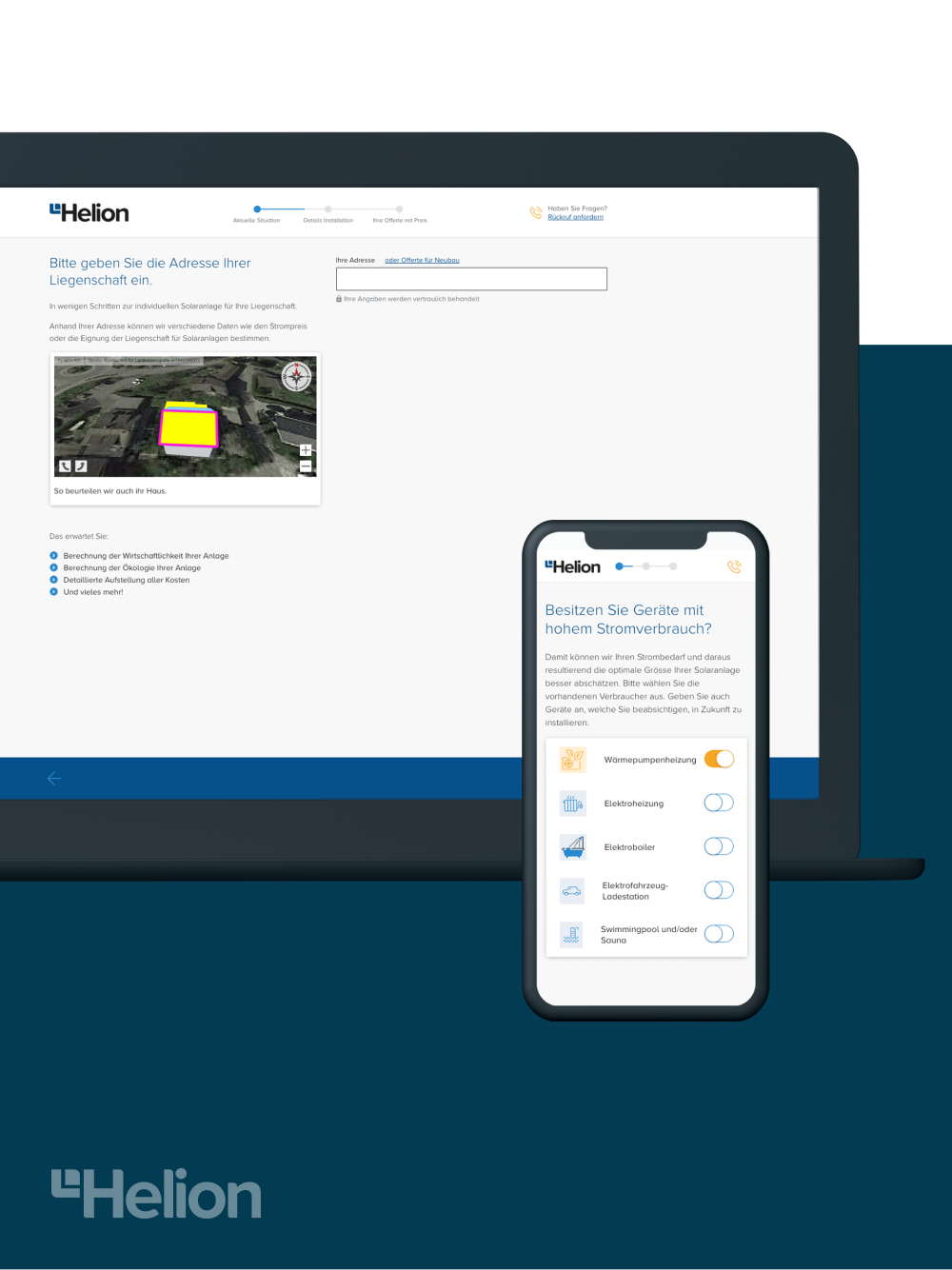
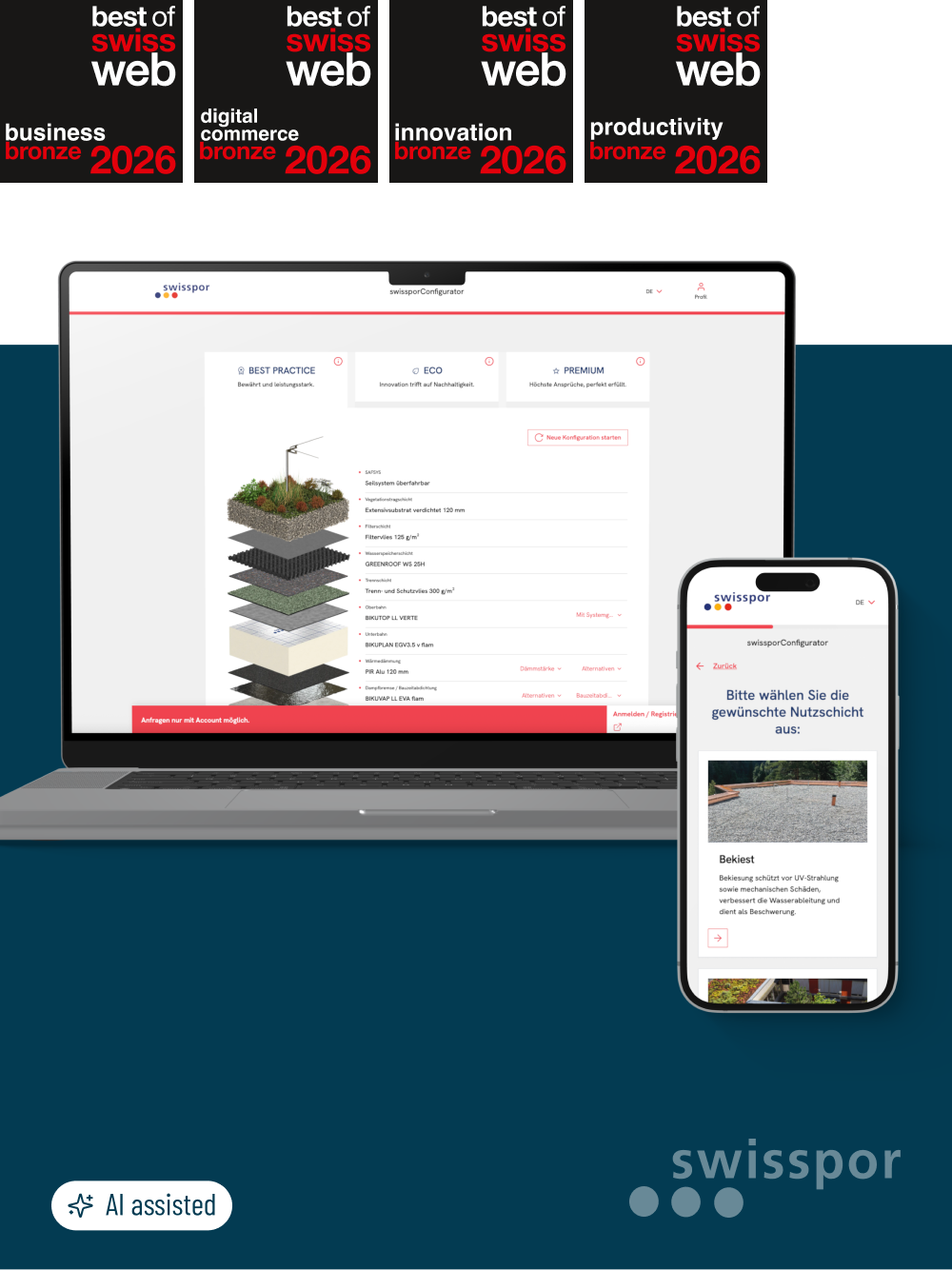
Digital sales systems in practice
FAQ
- What is a digital sales engine?
A digital sales engine is a digital sales system that connects processes, data, people and systems. It helps companies to qualify leads, configure complex products, prepare quotations more quickly and transfer orders seamlessly into existing systems. This reduces the sales team’s reliance on manual work and individual experts. The result is shorter quotation times, lower sales costs and a higher chance of closing deals.
- Who is a Digital Sales Engine suitable for?
It is suitable for companies that offer consultancy-intensive, customisable or technically complex products and services.
- What is the difference between CPQ and a digital sales engine?
CPQ supports configuration, pricing and quotation generation. A digital sales engine takes this a step further by combining CPQ with lead generation, guided selling, customer portals, system integration, data analysis and continuous optimisation.
- How does a digital sales engine make the sales function Agentic-ready?
Sales representatives need structured product data, a clear sales process and integrated systems. A digital sales engine provides this foundation and enables the effective use of AI features such as guided selling, quotation assistance and agentic commerce.